
Tokyo Haneda Airport handles an enormous amount of foot traffic every single day. Three terminals, multiple floors in each, rail lines running underground, shuttle buses circling between buildings, and thousands of passengers moving in every direction at once – there is too much going on in a single space indeed. For first-time visitors, especially those stepping off a long-haul flight and trying to figure out where to go next, the experience can feel genuinely overwhelming.
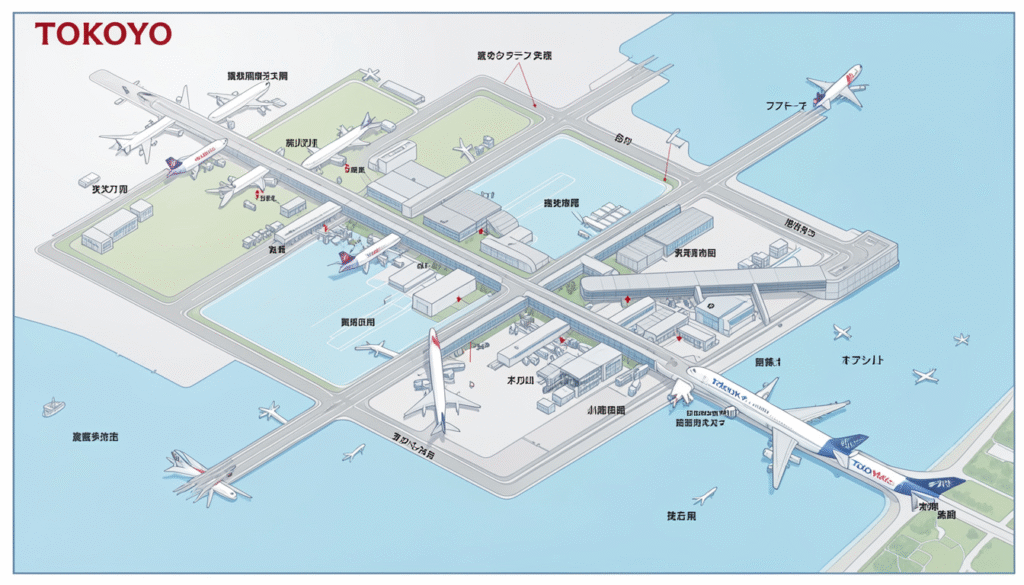
This guide is all about the Tokyo Haneda Airport (HND) Map. When you have the map at hand, navigating the airport becomes easier. Read on to know more.
Understanding Haneda’s Three Terminal Structure Through the Interactive Map
Haneda Airport operates three passenger terminals: Terminal 1 (T1), Terminal 2 (T2), and Terminal 3 (T3).
Terminal 3 is mainly reserved for International flights. In fact, it was initially called the International Terminal and was renamed Terminal 3 on the 14th of March 2020. However, Terminal 2 also serves international flights alongside domestic departures. Terminal 1, however, handles domestic flights.
Terminal 1 (T1)
Terminal 1 is laid out across the following floors:
- RF — Observation Deck
- 6F — Convention Hall and Observation Deck
- 5F — Rental Conference Rooms, Restaurants, and THE HANEDA HOUSE
- 4F — Restaurants & Shops
- 3F — Restaurants & Shops, Parking Lot Passageway (P1, P2)
- 2F — Departure Lobby, App-dispatched and Reserved Taxi Stands
- 1F — Arrival Lobby, Bus & Taxi Stand, Inter-Terminal Free Shuttle Bus Stand
- B1F — Keikyu Line / Tokyo Monorail, Passageway to Terminal 2
If you’re departing domestically from T1, your check-in and departure procedures happen on the 2nd floor. Arrivals come in on the 1st floor, where you’ll also find the shuttle bus stand and access to ground transport. The B1 level is where both the Keikyu Line and Tokyo Monorail trains are located, and it also connects directly to Terminal 2 via an underground passageway.
Terminal 2 (T2)
T2 is a dual-function terminal, handling both domestic and international passengers across different floors.
Terminal 2 floors are structured as follows:
- 5F — Restaurants, Observation Deck, FLIGHT DECK TOKYO
- 4F — Restaurants & Shops
- 3F — Restaurants & Shops, Departure Lobby (International), Parking Lot Passageway (P3, P4)
- 2F — Departure Lobby (Domestic), Arrival Lobby (International), App-dispatched and Reserved Taxi Stands
- 1F — Arrival Lobby (Domestic), Bus & Taxi Stand, Inter-Terminal Free Shuttle Bus Stand
- B1F — Keikyu Line / Tokyo Monorail, Passageway to Terminal 1
In Terminal 2, the international departure floor is located on the 3rd floor on the south side of the terminal. The international arrivals floor is on the 2nd floor on the south side, the same floor as the domestic departures lobby.
If you’re arriving on an international flight into T2, head to the 2nd floor. If you’re departing internationally from T2, your departure lobby is on the 3rd floor.
Terminal 3 (T3)
Terminal 3 is the primary international terminal at Haneda. It’s also the most destination-rich for dining and shopping experiences.
Terminal 3 floors are laid out as follows:
- 5F — Restaurants & Shops, TOKYO POP TOWN, Observation Deck
- 4F — Restaurants & Shops, EDO MARKET PLACE, TIAT SKY HALL
- 3F — Departure Lobby, Station Entrance
- 2F — Arrival Lobby, P5 Parking, Bus Stop Passageway, Station Entrance
- 1F — Entrance Plaza, Inter-Terminal Free Shuttle Bus, Bus / Taxi
International departures from T3 are processed on the 3rd floor. Arriving passengers from overseas enter through the 2nd-floor arrival lobby. The station entrances for both the Keikyu Line (underground) and Tokyo Monorail (elevated, connected to the 3rd floor) are accessible from T3.
https://platinumaps.jp/d/haneda?culture=en&area=7&floor=2F
Getting Between Terminals — All Options Explained at HND
Moving between T1, T2, and T3 is something a lot of passengers need to do — especially when you intend to switch from domestic to international flights or vice versa. There are several ways of traveling between terminals using the following modes:
- Free shuttle buses
- Tokyo monorail
- Underground passageway
- Transit ramp bus
Free Shuttle Bus
The shuttle bus is the most straightforward option for most passengers. It’s free and runs on a clear route between all three terminals.
From Terminal 1: The first departure to T2 is at 4:55 am, and the last is at 1:23 am. The first departure to T3 is at 5:04 am, and the last is at 1:32 am.
From Terminal 2: Buses run to T1 and T3, with the first departure at 5:00 am and the last at 1:28 am.
From Terminal 3: buses run to T1 and T2, with the first departure at 4:47 am and the last at 1:15 am.
Buses operate at 4-minute intervals from 5:00 am to 8:00 pm and at 8-minute intervals from 8:00 pm to 12:00 am.
Shuttle Bus Stops by Terminal:
- T1: 1st floor (Arrival Lobby), Bus Stop 8
- T2: 1st floor (Arrival Lobby), Bus Stop 9
- T3: Bus Stop 0 on the 1st floor of the passenger terminal
Wheelchair users can board without a prior reservation; the staff will assist.
Keikyu Line and Tokyo Monorail (Free Transfer Tickets)
Boarding tickets are free for those transferring between terminals on domestic-to-international, international-to-domestic, or international-to-international flights. You can use these tickets to travel between Terminals 1-3 and Terminals 2-3 on the Tokyo Monorail or Keikyu Line.
You will be asked to present your passport and flight tickets as proof of identity and travel. Tickets are available at the Information Counters in Terminals 1 (B1F), 2 (B1F), and 3 (2F).
Underground Passageway (T1 to T2)
One can use it to commute between Terminals 1 and 2. This moving walkway has an approximate length of 400m.
At present, a part of this walkway is temporarily out of service due to construction in the connecting walkway. Movement between T1 and T2 is still possible — check the official website for the latest updates.
Train and Monorail Connections at HND Airport
Two rail lines serve Haneda Airport. Both connect the airport to central Tokyo and are accessible from the underground floors of their respective terminals.
- Keikyu Airport Line: The Keikyu Line platforms at T3 are located underground, with elevators and escalators connecting to the arrival and departure levels. The West Exit of the T1/T2 station leads to Terminal 1, and the East Exit leads to Terminal 2.
- Tokyo Monorail: The Monorail platforms at T3 are elevated and located on the 3rd floor of the terminal building. The T1 and T2 Monorail stations are underground and serve their respective terminals directly.
To find transportation options easily, please refer to HND’s interactive map.
HND Airport’s Information Displays and Signage
Information displays for main facilities are written in four languages: Japanese, English, Korean, and Chinese. Pictograms make information easy to understand for everyone.
There are six information desks located in Terminal 1 and six in Terminal 2. Information Counters are also present in Terminal 3. These counters are where you can ask for directions, collect Transit Boarding Tickets for rail travel between terminals, and get general airport guidance.
Accessibility Features Across All Terminals at HND
Tokyo Haneda Airport (HND) boasts a variety of accessibility features in all its terminals designed to make the travel experience pleasant and easy for everyone. Passengers in need of specific assistance can avail of services such as wheelchairs, easy-to-use restrooms, lifts, escorts, and other facilities, which are spread throughout the airport.
- Voice-Guided Elevators: Elevators feature voice guidance for every floor and provide ample interior space to accommodate two electric wheelchairs side by side.
- Spacious Moving Sidewalks: Terminal 2 features a 1.4-meter-wide moving sidewalk, which is wide enough for a person to walk comfortably alongside a wheelchair.
- Enhanced Sidewalk Safety: Lights and voice guidance alert passengers as they step on or off the moving sidewalk to prevent accidents.
- High-Visibility Sidewalk Markings: Green surface lines on the moving sidewalk improve visibility, helping elderly passengers and individuals with impaired vision easily gauge the walkway’s motion and speed.
- Accessible Communication Boards: Writing communication boards are available at Information Counters across all three terminals, as well as at Terminal 3 airline check-in counters, security checkpoints, and immigration control.
- Multipurpose Toilets: You will find one or two multipurpose toilets at each location. They can be accessed by elderly passengers, wheelchair users, passengers traveling with infants, and so on.
- Drugstore: The airport has several stores selling medicines for colds, travel sickness, and more. You will also get other travel essentials, such as earplugs and chewing gum.
The HANEDA MAP and Official Navigation App
The official Haneda Airport website offers two dedicated digital tools for in-airport navigation.
- HANEDA MAP — An interactive map accessible directly from the floor guide pages on tokyo-haneda.com. It allows passengers to search routes between facilities inside the airport and is available in Japanese, English, Korean, Simplified Chinese, and Traditional Chinese.
- HANEDA Navigator App — HANEDA Navigator guides you in locating the facility with ease, helping ensure a stress-free journey. The current position display feature is available only for iOS (Apple). Navigation times shown are for reference. The app is available for both iOS and Android and is free to install.
Shops And Restaurants At the Tokyo Haneda Airport – Check Them Out On The Interactive Map
When at the HND Airport, you will find plenty of stores and eateries to ensure you don’t get bored as you await your flight. You might wish to purchase a travel essential that you forgot to pack at the last moment. You might even desire to grab a quick bite before boarding your flight. The HND Airport has it all. Some of the prominent shops and restaurants include:
- Haneda Star Sweets
- PIER 1
- PIER 4
- Soraben Kobo
- Captain’s Market
- Food Plaza
- Ariso Sushi
- Meat Stars 29
- Ginza Kiya
- Curacion Cafe
For precise locations, HND’s map will come in handy, helping you see the exact directions with ease.
Conclusion
Haneda Airport’s three-terminal layout is genuinely well-organized once you understand the logic behind it. T1 and T2 are for domestic flights (with T2 also covering select international routes), while T3 is the primary international hub. Floor numbers are consistent in their logic across all terminals, arrivals on 1F or 2F, departures above that, dining and shopping higher up, and trains underground.
The free shuttle bus, underground walkway between T1 and T2, and free transit tickets for rail travel make getting between terminals straightforward. Using the Tokyo Haneda Airport (HND) Map, the HANEDA MAP tool, and the Navigator app makes navigation even easier, helping passengers move around the airport without confusion.
FAQS
You can travel around between HND terminals by using the free shuttle buses, taking the Keikyu Line, Tokyo Monorail, or walking through the underground corridors linking terminals.
The shuttle bus stop is on the 1st floor (Arrival Lobby) of each terminal. At T1, it’s Bus Stop 8; at T2, it’s Bus Stop 9; and at T3, it’s Bus Stop 0 on the 1st floor of the passenger terminal.
Terminal 3 is the primary international terminal. Terminal 2 also handles international flights. The international departure lobby is on the 3rd floor, south side, and the international arrival lobby is on the 2nd floor, south side of T2.
HANEDA Navigator is the official free app from Haneda Airport Passenger Terminal. It provides flight and facility information searches, bookmarking, and in-airport navigation. The current position display function is available only for iOS. You will find it on Google Play or App Store.
HND terminals provide elevators that are accessible to people with disabilities, escalators with voice guidance, wide moving sidewalks, and shuttle buses for wheelchairs. Direct staff assistance is available to them without making prior reservations.